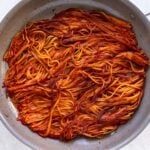
Spaghetti all'Assassina (Assasin’s Spaghetti)
Spaghetti all’Assassina or “Assassin's Spaghetti” is a spicy charred pasta dish that really breaks the mold. A pasta dish popularized by Stanley Tucci: Searching For Italy, it gives new meaning to the term “one pot pasta.” In this intriguing dish, the spaghetti is cooked risotto-style in a hot skillet, adding tomato broth little by little until scorched and crunchy.
Servings: 2 servings
Calories: 616kcal
Ingredients
- 3 ½ cups water
- 1 ½ cups tomato passata
- 1 ½ teaspoons kosher salt plus more as needed
- 2 tablespoons extra-virgin olive oil
- 2 cloves garlic minced or crushed
- ½ teaspoon dried chili flakes scale up or down based on spice preference
- 1 tablespoon tomato paste
- 8 ounces (225 grams) dried spaghetti
Instructions
- Combine the water, tomato passata and salt in a medium saucepan and bring to a simmer. You will add this mixture to your skillet occasionally throughout the cooking process.
- Add the olive oil to a 12-inch or larger nonstick skillet or cast iron pan over medium-high heat. Add the garlic and dried chili flakes and cook for about 30 seconds or just until fragrant but not too browned. Stir in the tomato paste and cook for another 30 seconds or so.
- Ladle in just enough of the diluted tomato passata mixture from the saucepan to evenly cover the bottom of the skillet, about ½ cup. Add the spaghetti in an even layer spreading it out in the skillet.
- Cover with about 1 ½ cups more of the tomato passata mixture. Wiggle the spaghetti around a bit to make sure it’s mostly submerged, but otherwise don’t move it too much. You want it to stick and char to the bottom a bit. Let it cook undisturbed until most of the broth is absorbed and the spaghetti is starting to stick to the bottom, about 5 to 7 minutes.
- Use silicone spatulas or tongs to carefully flip the spaghetti over so the bottom is now facing up (it may be easier to flip the spaghetti over in two halves). Continue to add about 1 cup of tomato passata mixture at a time, letting each addition absorb into the spaghetti undisturbed for about 3 to 5 minutes as needed. Between additions, continue to carefully flip the spaghetti over from top to bottom so it cooks evenly.
- Repeat the process until the spaghetti is al dente, sticks to the bottom of the pan and is a bit charred. The process requires some patience and attention. The total cooking time will be about 20 to 25 minutes from when you start adding broth. Serve immediately.
Notes
- Pasta: Only use dried spaghetti and save your other long pasta shapes for another day. It’s usually recommended to use a cheaper variety rather than premium bronze extruded pasta here since the starch level of premium pastas can interfere with the charring.
- Tomato Passata: The ability to purchase bottles of tomato passata is a game changer. Passata is an uncooked tomato purée that has been strained of seeds and skins. It’s not the same as canned tomato sauce, which has seasoning added to it.
- Dried Chili Flakes: This is meant to be a spicy pasta, but you can certainly modify the amount of chili flakes to your preference. I think ½ a teaspoon is plenty for 8 ounces of spaghetti but you can definitely add more. Calabrian chili flakes are the authentic option here, but any dried chili flakes will work in a pinch.
- Refrigerate leftovers for up to 4 days. This is a dish that would be best reheated on the stovetop in a nonstick pan (with a few splashes of water added as needed) rather than in a microwave.
- You really need a wide enough skillet to accommodate the length of unbroken spaghetti. You may be killing the spaghetti and scorching it in the pan, but the real crime would be breaking the spaghetti to fit it into a smaller pan. Please don’t do that. Use a 12-inch or wider nonstick skillet or cast iron pan.
- Before cooking your spaghetti all’assassina, measure how much water your ladle holds. I used a ladle with a ½ cup capacity. This made it easy for me to ladle tomato broth knowing exactly how much I was adding each time. I used one ladle to start (½ cup), then three ladles over the spaghetti (1 ½ cups) and then two ladles for each of the following additions (1 cup).
- For flipping over the spaghetti, I like to do it in two halves using two silicone spatulas, one underneath the spaghetti and one over the top to hold it down. Then I flip each half of the spaghetti.
Nutrition
Calories: 616kcal | Carbohydrates: 107g | Protein: 16g | Fat: 16g | Saturated Fat: 2g | Polyunsaturated Fat: 1g | Monounsaturated Fat: 10g | Sodium: 1206mg | Potassium: 986mg | Fiber: 10g | Sugar: 14g
Check out the original post for more information, step-by-step photos, and more by scanning this QR code!